Creating a supportive ecology for fruit trees
This is about much more than individual trees and is about creating healthy, supportive ecologies both above and below ground.
The importance of healthy living soils and fungi in particular
Healthy living soil is essential for healthy plants but also helps to keep carbon in the soil and even to sequester it, thereby helping in the fight against climate change. Increasing soil carbon also increases the water holding capacity of soils making them much more resilient to both drought and floods.
Mycorrhizal fungi are of particular significance. They exist in healthy soil and form a symbiotic relationship with plants via their roots. As fungi can’t photosynthesize they rely on the carbon captured by plants in order to thrive. Mycorrhizal fungi establish connections with the roots of living plants and create a mycelial network which has the potential to expand the reach of a plants access to nutrients and water by upwards of 100 times! Essentially the plants hand out photosynthetically produced carbon to their friendly neighbourhood fungi, and the fungi provide nutrient and water gifts that the plant roots would have no way of reaching on their own.
Our role as gardeners and growers is to support a healthy soil food web including these fungal networks.
Creating / supporting living soil
The first principle is to do no harm so that means no spraying of herbicides or pesticides and no use of artificial fertilisers. We need to support the life of the soil and to help shift the balance from bacterial to fungal dominance. When planting, particularly on clay soils, it is important to ensure good drainage and good aeration.
If buying inputs then only use quality organic fertilisers and minerals.
There are lots of home made / foraged inputs that we can use including
- seaweed
- biochar
- ramial wood chip (more about ramial wood chip later)
- manure
- mulch
- compost
- humanure
- sheeps wool
Use of support plants – trees, shrubs, herbaceous plants
The best way to create a vibrant, healthy living soil is to maximise photosynthesis through planting adiverse range of plants. We know that different plants have different properties so the more diverse the plants are the more variety of micro phyto nutrients that are available.
Ideally we want fast growing plants that are cheap to propagate and that supply lots of biomass that will rot down to feed the system. Some great examples are tithonia, bana grass, acacias, abyssinian bananas and canna lillies.
It’s helpful to create guilds of plants with similar needs that can support each other.
By chopping and dropping or by chipping and mulching nutrients are cycled through the planting. Trees and other plants such as comfrey are mineral accumulators or dynamic accumulators. These plants bring minerals from deeper within the soil and make them available to the fruit trees either through their leaves or when they are cut and decay.
Some support plants are nitrogen fixing making this available through their roots. They tend to be fast growing and also provided nutrients as they are pruned and either dropped around the plants or chipped.
Other plants within a system support beneficial insects or other wild creatures.


Animals / birds in system
Different species of domestic birds serve different functions eg geese eat grass, chickens and guinea fowl help with pest control, ducks eat slugs and snails. All help provide fertility!
Grazing animals can be used to support a system if done wisely, often at the end of winter when trees are not in leaf.
Management of animals in a system is necessary – all species have pros and cons and can cause damage if not managed well. Birds are least damaging although chickens tend to kick mulch about. Chickens and pigs can help clear up fallen fruit and break the life cycle of pest species. Geese eat comfrey and can kill it. Geese can be damaging to fruit trees particularly in late winter and spring when they can damage bark by nibbling it presumably to access minerals. Best kept out at these times and when nesting. Sheep can be helpful – best only in winter. Generally speaking cows are too big and heavy to be useful for other than very short periods. Pigs can be damaging if they root.
It’s helpful to design the system so that support plants provide food for the animals in system.
As the system matures then trees are less susceptible to damage from browsing.
Ongoing management
We are aiming for “low” not “no” maintenance – productive systems require some maintenance including pruning, refereeing, health promoting strategies such as foliar feeding, mineral inputs until cycling established, moving fungally dominated soils through chopping and dropping and mulching. Fungal networks are particularly susceptible to disturbance and are damaged / killed by pesticides, herbicides and artificial fertilisers so use of any of these would be a backwards step in terms of soil health and creating a fungally rich soil.
Actively observing and interacting is important.
Challenges
Kikuyu – the best method to deal with kikuyu is by planting thickly and shading it out. In some situations scything the kikuyu and using it as mulch is required and in those instances chop and drop can be problematic until the kikyu is weakened as it can climb over the chop and drop and be difficult to manage.
Wet and dry weather cycles -the best way to deal with wet and dry cycles is by planting thickly and building soil organic matter to help retain the water and stop the soil drying out.
Pest control – possums are the main problem for deciduous trees. Trapping and shooting are the best methods of control. Reducing the population from early spring and keeping onto it can make a real difference at harvest time.
Birds can be a problem taking ripe fruit. This can be helped by diverse plantings which are very productive so that the birds can take their share and leave some for us. Healthy wild ecologies nearby that also meet their needs are important. Netting can be used in specific situations but in honesty is a pain to do.
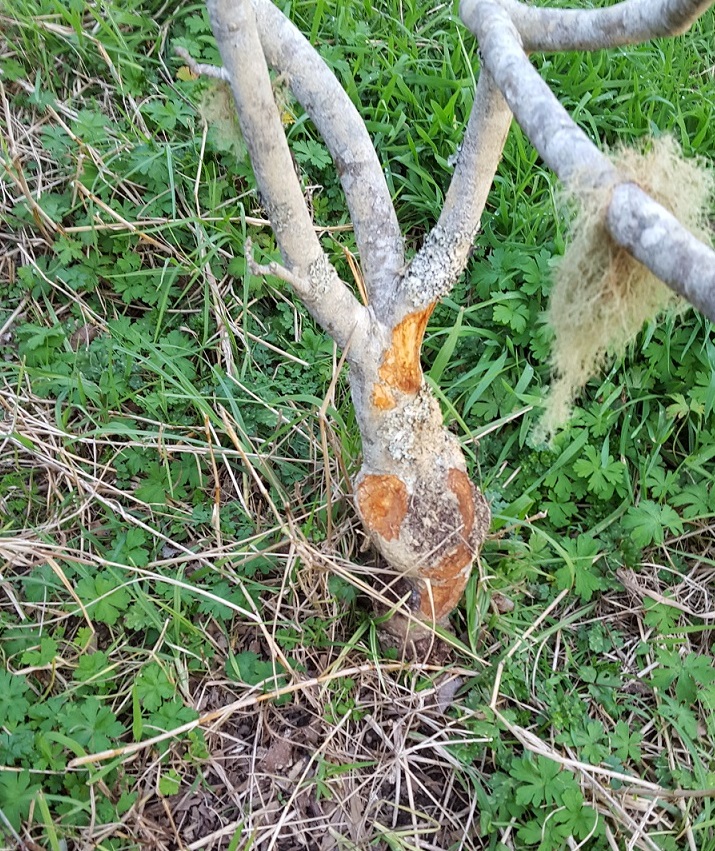
Hares and rabbits can do extensive damage to fruit trees through eating their bark and can even ring bark a tree. Apple trees seems to be particularly vulnerable. Trunk protection can be used. Our most effective method of healing damage, even ring barking, has been to plaster fresh organic cow manure all over the wound and keep it in place by tying a cloth around it. The trunk would also need protection and a wire cage is better than a piece of drainage coil or similar which tends to make it too damp inside.
We are also experimenting with tree paste made from cow manure and clay which has health benefits for the tree and that we hope will be an unpalatable deterrent. The photos show hare damage to an apple tree and the same trunk after tree pasting to help it heal and inside a cage to keep the hare off! For really deep damage we’d use the fresh cow manure and cloth method detailed above.


More about ramial wood chip
Ramial wood chip can be an important tool in supporting a healthy soil food web including fungal networks in the soil.
Ramial wood refers to branches and twigs that are no more than 7cm in diameter. This smaller growth contains the majority of enzymes, minerals, proteins, amino acids and phytohormones of the tree and by chipping only this smaller wood these nutrients become available.
Also crucial is to make ramial wood chip from mainly deciduous trees and to avoid using conifers and other evergreen species as these don’t fully break down and can work to suppress the plants we are wanting to nourish.
Ramial wood chip has a balanced carbon to nitrogen ratio of between 30/1 and 70/1 which can be digested easily by the soil food web. Trunks and larger wood have a much higher carbon to nitrogen ratio. Of course these can also be chipped but, if they are going to be used, they must be thoroughly composted with a high nitrogen component otherwise they will tie up all the nitrogen in the soil and negatively affect plant growth.
Pest challenges and disease issues are really about biological and nutritional deficiency. The use of ramial wood chip can help to promote plant health and immunity by providing nutrients and supporting the soil food web.